
The Leader’s Aperture: Mastering How to Focus Your LIGHT
- David Frandsen
- Dec 14, 2025
- 5 min read
In a previous article, the LIGHT framework was introduced as a guiding philosophy where leaders cultivate the vital energy of their team through Love, Interpersonal relationships, Growth, Health, and the transformation of Toxicity. LIGHT represents the essential way leaders shine on their people to illuminate clarity, purpose, and connection.
At the heart of this framework is the leader’s role: to cultivate LIGHT intentionally, nurturing and guiding the energy of their people.
Today, we deepen this concept by introducing a complementary metaphor: the leader’s aperture. Borrowed from photography, aperture vividly illustrates a leader's ability to regulate and focus their LIGHT. Understanding and developing this skill is crucial for leaders who wish to cultivate their leadership presence and impact fully.
What is aperture in photography?
Aperture is the adjustable opening in a camera lens that controls how much light enters to expose the image sensor. Skilled photographers manipulate aperture to shape what is visible and how it is presented—either isolating a single subject or keeping the entire scene sharp.
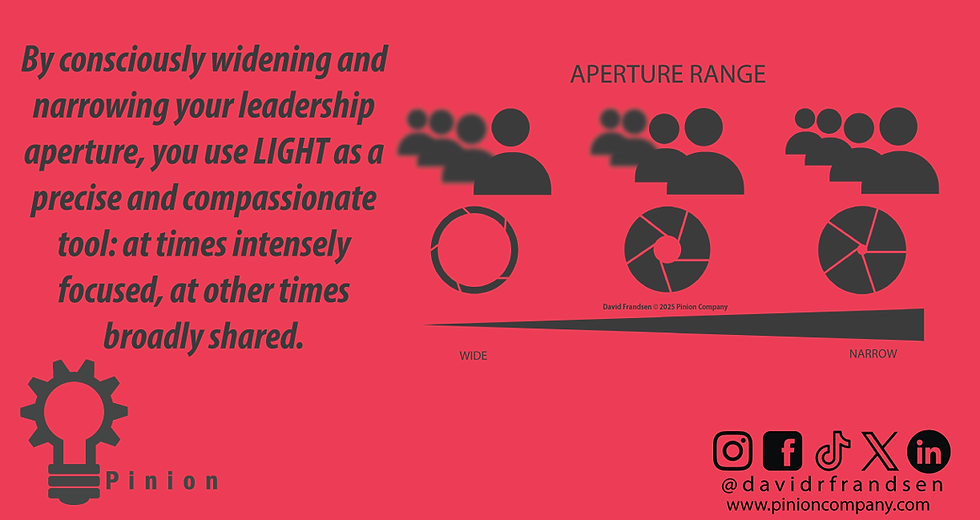
A wide aperture lets in more light and creates a shallow depth of field, where one subject is in sharp focus while the background is softly blurred. A narrow aperture lets in less light but creates a deeper depth of field, keeping more of the scene—from foreground to background—in clear focus.
For leaders, this becomes a useful metaphor: sometimes leadership calls for an intense focus on one person or issue, and at other times it requires seeing the whole landscape of the team or system.
Leadership aperture defined
Leadership aperture refers to the way a leader intentionally adjusts focus—how tightly or broadly they direct their attention, energy, and information gathering.
It spans a range:
· From a wide aperture, where a leader concentrates LIGHT on a specific person, moment, or issue that needs depth, care, and precision.
· To a narrow aperture, where a leader distributes LIGHT across the broader team or system, taking in patterns, culture, and collective dynamics.
Developing the capacity to flexibly widen or narrow this aperture based on context is a developmental skill critical to effective leadership.
The leader’s role: cultivating LIGHT through aperture
Leaders are more than sources of light—they are cultivators who shape how this light is shared within their team and organization. The leader’s aperture symbolizes the essential skill of discerning when to concentrate LIGHT and when to distribute it more broadly.
· A wide aperture approach channels intensive focus toward individual development, specific challenges, or crucial opportunities that require clarity and precision. In these moments, the leader’s LIGHT spotlights one person or issue so that growth, feedback, or decision-making can happen in a deeply supported way.
· A narrow aperture approach pulls more of the environment into focus, allowing the leader to see the wider team, culture, and system. Here, the leader’s LIGHT extends across the group to illuminate trends, relationships, and overall health.
The most effective leaders know that cultivating LIGHT is not about shining brightly all the time but about mastering where and how to focus their energy.
Recognizing the need to develop your aperture skill
Developing leadership aperture means:
· Being aware of the changing needs of the team and organization.
· Making intentional choices about where to direct your attention for maximum impact.
· Balancing when to step back and see the whole system and when to lean in and focus on a specific person or challenge.
· Using wisdom to know which aperture setting best fits each leadership moment.
This skill transforms leadership from a static state of shining light into a dynamic art of lighting—an ever-adapting process essential for thriving teams and healthy organizations.
Putting aperture into practice
Here are some practical examples that show when to choose a wide or narrow aperture as a leader.
When to choose a wide aperture
These are moments where you “open up” to pour LIGHT into a specific person, conversation, or problem:
· Coaching a struggling team member
A normally strong performer has slipped—missed deadlines, quiet in meetings, visible frustration. This is a wide aperture moment: you clear time for a one-on-one, listen deeply, ask coaching questions, and co-create a plan. Your LIGHT is intentionally focused on this one person and what they need next.
· Navigating a critical decision- A key project is off track and the next move will affect budget, deadlines, and trust with a major client. You choose a wide aperture setting by gathering a small group of key stakeholders, diving into the data, and exploring tradeoffs in detail. Your focus is on this single decision and the people closest to it.
· Giving meaningful feedback- After a high-stakes presentation, you schedule a debrief with the presenter. You close your laptop, silence notifications, and walk through what went well and what could improve. Your attention is concentrated on helping this one person grow.
When to choose a narrow aperture- These are moments where you “tighten” the aperture so more of the scene comes into focus: patterns, culture, and relationships across the group:
· Sensing team culture and morale
You notice an increase in side conversations, slower email responses, and fewer ideas being offered in meetings. Instead of jumping into one person’s behavior, you shift to a narrow aperture: you look at engagement data, listen in team discussions, and ask open questions in skip-level meetings. You are bringing the whole team into focus to understand what is happening systemically.
· Designing org-wide changes
You are considering a new hybrid work policy. Rather than reacting to the loudest voices, you use a narrow aperture setting: you gather input from multiple teams, look at performance trends, and consider equity, role differences, and long-term culture impacts. You are intentionally seeing the full picture before deciding.
· Planning development for the whole group
You realize several people across the team are bumping into similar skill gaps: difficult conversations, prioritization, cross-team collaboration. You narrow the aperture by zooming out from any single person and asking, “What does this team need to grow as a whole?” That leads to a team workshop or shared learning experience instead of only individual fixes.
You can cue readers with a simple rule of thumb: when an individual is stuck, needs feedback, or faces a pivotal moment, choose a wide aperture; when you sense patterns, cultural shifts, or systemic challenges, choose a narrow aperture.
Personal reflection: learning to adjust my aperture
Early in my leadership journey, I often found myself getting deeply involved in the weeds of certain projects, trying to put my stamp on everything. I wanted to be involved in all the details because I cared, but despite my good intentions, this approach often left me feeling burned out. More importantly, I realized it could sometimes feel burdensome for my team, making them feel micromanaged or less empowered.
At the same time, there were moments when a team member was clearly struggling or seeking guidance in a particular area. Those were the times when stepping in—widening my leadership aperture—was incredibly valuable for both of us. Offering focused advice or direction helped that individual regain clarity and momentum.
The tricky part, and what I learned over time, is that knowing when to zoom in on an individual and when to pull back to see the whole team requires intentionality. Cultivating this skill of adjusting my leadership aperture—when to be hands-on and when to give space—became essential in managing my LIGHT effectively and supporting my team’s growth.
Conclusion: mastering your LIGHT
Leaders who learn to work with their aperture move beyond a one-speed style of leadership. They become intentional about when to spotlight a person or decision and when to illuminate the wider system and culture.
By consciously widening and narrowing your leadership aperture, you use LIGHT as a precise and compassionate tool: at times intensely focused, at other times broadly shared. Over time, this practice strengthens trust, accelerates growth, and builds a healthier, more connected team—one that is consistently illuminated by the way you choose to lead.


Comments