
Snowplow Leadership: Why Great Leaders Let Their Teams Struggle
- David Frandsen
- Jan 18
- 3 min read
Months ago, I wrote about the Emperor Moth and The Coddling of the American Mind, exploring how overprotection—whether in parenting or elsewhere—robs people of the essential struggle that builds resilience and strength. Today, that same dynamic plays out in leadership. We’ve all heard of “snowplow parenting,” where well-meaning parents clear every obstacle from their kids’ paths. In the workplace, we do the exact same thing: snowplow leadership. We rush in to solve problems, remove hurdles, and make things easier, believing we’re helping. But just like the moth that never flies when its cocoon is cut open, our people never fully develop when we take away their chance to push through.
The Emperor Moth at Work
Remember the Emperor Moth? It must force its way through a tiny opening in its cocoon, pumping fluid into its wings to make them strong enough for flight. Cut that struggle short, and it emerges weak, bloated, and grounded forever. At work, every project, deadline, or challenge is someone’s cocoon. When leaders plow ahead—rewriting reports, fixing budgets, or handling tough conversations for their teams—they create the same tragedy. Short-term ease trades away long-term capability. Struggle isn’t the enemy; it’s the mechanism that turns potential into strength.
What Snowplow Leadership Looks Like
Snowplow leaders mean well. They see a team member stuck and think, “I can fix this faster.” They jump in to resolve client issues, build the perfect spreadsheet, or micromanage a presentation. It feels heroic. But over time, it breeds dependence, erodes confidence, and kills initiative. Elizabeth Lotardo, a leadership coach who’s written and spoken extensively on self-leadership, nails this: leaders must stop solving their team’s problems for them. Her advice? Ask, “What have you tried? What support do you need from me?” instead of handing over the solution. By always plowing the path, we keep our people from ever learning to navigate it themselves.
I’ve Made This Mistake Too
For me, this hits close to home with something as simple as spreadsheets. I’ve built thousands over the years—for planning, tracking, analysis—and I actually enjoy it now. But I only got good through endless reps: trial and error, broken formulas, hours of frustration. Early in my career, when a newer manager or employee needed one, I’d say, “Here, I’ll just build it for you.” It was faster. It felt helpful. And honestly, I liked doing it. But that was snowplow leadership—I was cutting their cocoon. These days, I let them take the first pass. I stay close, answer questions, coach on structure or shortcuts, but I make them struggle through it. Most people are made in that struggle; it’s what turns “I hate this” into “I’ve got this” and eventually “I love doing this well.” If those messy reps built my skill and joy, why rob them of the same?
What Great Leaders Do Instead
Great leaders don’t plow; they prepare the traveler. Drawing from Lotardo’s work on self-leadership, they shift from fixer to coach: remove systemic barriers (like unclear processes or bad tools) while leaving the personal growth work intact. They ask powerful questions—“What would you do if I weren’t here?” or “What’s the next step you’ll take?”—sparking ownership. They create safety nets, not snowplows: clear expectations, regular check-ins, and freedom to fail forward. This builds not just skills, but antifragility—people who get better through pressure, like the moth’s wings expanding under strain.
Let Them Struggle to Soar
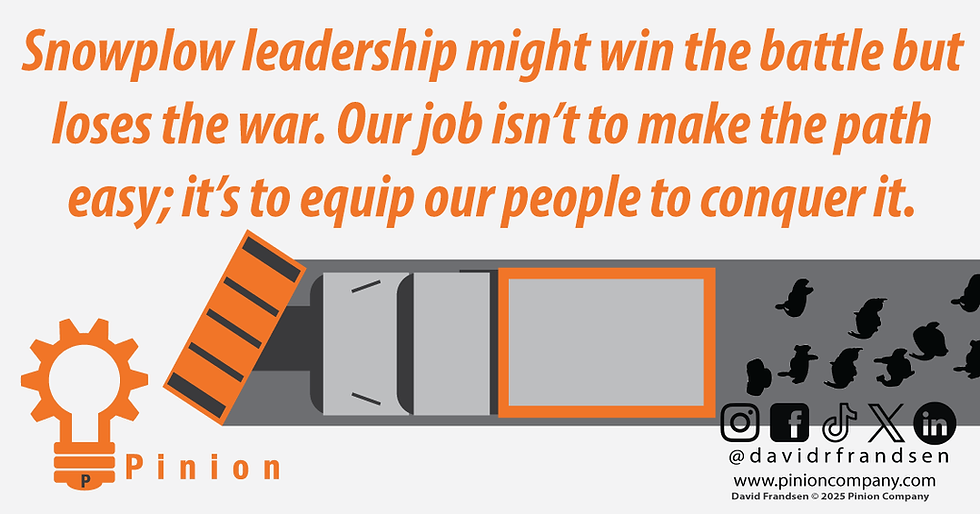
Snowplow leadership might win the battle but loses the war. Our job isn’t to make the path easy; it’s to equip our people to conquer it. As I’ve seen in my own teams, the hardest challenges—the ones we face head-on together—forge the tightest bonds and the strongest contributors. Next time you feel the urge to step in, pause. Let them push through the cocoon. Offer guidance, not the answer. Watch what happens when they emerge not just capable, but confident enough to fly. That’s leadership that lasts.
#Pinion, #GearUpForSuccess, #ImposterSyndrome, #GearUp, #GearUpYourOrganization, #LeadershipDevelopment, #Leadership, #LeadershipSkills, #LeadershipTraining, #ProfessionalDevelopment, #LeadershipCoaching, #PersonalGrowth, #CareerDevelopment, #LeadershipQuotes, #LeadershipGoals, #Coaching, #Entrepreneurship, #Mindset, #Success, #PersonalDevelopment, #BusinessStrategy, #ProfessionalGrowth, #LeadershipMatters, #LeadershipLessons, #Empowerment


Comments